Envision Beyond Journal
The Future of Business
By Marco Cigaina, Emek Yeşilyurt & Jose Carvalho
Originally published
This issue is about the Future of Business. Read and discover new insights through the four lenses of the future of business, explore the qualities of an intelligent sustainable enterprise and the key initiatives to future-proof an organization.
Four Lenses on the Future of Business
What does the future hold for business? A question that feels way too ambitious, too broad, too generic to answer concisely. And yet, we chose to open our new Envision Beyond Journal with just this. Because it certainly is one of the most important questions any business executive has to ask and think about. And while we at the Intelligent Enterprise Institute certainly don’t claim to have any definitive answers, we can provide four lenses to look into the future of business: people, enterprises, business networks, and the sustainable world.
Let’s start with people: people, not as abstract roles or job descriptions, but as concrete individuals with their personal background, ambitions, and emotions are at the center of the future of business.
And while the current context is characterized by a fierce competition for skills (often poorly labeled with martial language as “war for talent”) and the need for flexibility in the choice of work hours and location, we can see three new key aspects emerging that are shaping the future of work done by people:
A symbiosis of human and machine intelligence, where enterprise systems augment human potential and offer a personalized, contextual flow of information
The new reality of working across physical and virtual worlds (also a consequence of developing the metaverse as a new business environment)
The increasing pressure to renew management as we know it, foregoing micro-management and synthesizing classic management and self-organization in new governance structures and ways that people organize (often referred to as “holacracy”).

Which brings us to the level of enterprises.
One of the biggest challenges in any organization is how to balance the present and the future, and the different mindsets that go along with it. In 2004, HBR published an impactful article in which they elaborated the idea of an ambidextrous organization (first introduced by R.Duncan in 1976):
*We discovered that some companies have actually been quite successful at both exploiting the present and exploring the future, and as we looked more deeply at them we found that they share important characteristics. In particular, they separate their new, exploratory units from their traditional, exploitative ones, allowing for different processes, structures, and cultures; at the same time, they maintain tight links across units at the senior executive level. (...) We call these kinds of companies “ambidextrous organizations,” and we believe they provide a practical and proven model for forward-looking executives seeking to pioneer radical or disruptive innovations while pursuing incremental gains. *
Many years later, we believe we are on the cusp of a next generation of ambidextrous organizations. Advanced digitalization will act as the glue, the integrative enabler for coupling business execution and innovation in parallel. And with it, enterprise systems themselves will need to become ambidextrous. So how does this unfold and what are the implications?
As we progressively and steadily move from just automated to autonomous, self-running and self-optimizing operations, humans focus primarily on managing truly unprecedented exceptions and on renewing the logic and design of operations. Examples of the rapid evolution in this direction are already visible. For instance, in the supply chain space, we move from the current focus of managing volatility and improving cross-company collaboration for the sake of increased resilience to anti-fragility - a new paradigm in which learning from crises becomes key. Advanced digitalization coupled with resilience management helps companies not just to bounce back from crises to a state that they were in before, but emerge much stronger.
A more effective and sophisticated ambidextrous organization will also need to push agility to the upper limit. Here is where we see the composable enterprise coming into play with advanced modularization of business capabilities and the potential of re-arranging those capabilities to meet new market demands and address strategic shifts.
Moreover, steering future enterprises requires a more sophisticated data-driven approach to strategy, market opportunity analysis and business model management. Enterprise information systems will need to evolve. It is not just operational decision making and process optimization that they now need to support, but an increasingly more AI-assisted and adaptive strategic management, as well.
Let’s further zoom out, from individual enterprises to business networks. We see another major shift here: from reactive cross-company process integration to a highly dynamic, proactive context where companies, institutions, consortia, micro-businesses, and startups fluidly form business ecosystems that rapidly evolve to address systemic challenges or seize opportunities.
We see the increasing importance of such ecosystems, multi-sided business models, and the related platform economy. We see startups shifting from being disruptive threats to becoming integrated parts of the corporate innovation system. We witness the dawn of distributed autonomous organizations. In this context, seamless, digitally managed value flows of any kind (material, financial, information-related, etc.) become the backbone of business.

Finally, to understand what the future will hold for business, we need to consider an even broader perspective, moving on from business networks to the entire sustainable world.
Stakeholder economy, purpose-led management and the triple bottom line have become popular terms in the business world. Today’s consumers expect businesses to embrace sustainability and circular economy principles. And consequently, we are entering the era of widespread purpose-led business innovation in which serving societal and planetary needs, e.g. oriented on the United Nations Sustainable Development Goals, become central business goals, rather than just mere profit. An evolving use of technology and an ongoing cultural transformation will be the central drivers of the shift to re-balance economic, societal, and environmental perspectives in business.
Going forward, we foresee purpose outcomes, and particularly sustainability, to evolve from a reason that stimulates a profound corporate transformation to becoming an integral part of each business’ DNA - the reason and measure for doing business in the first place. On this path into the future, we already see businesses progressively shift to incorporate more profound human values and make business not just sustainable but also ethically and aesthetically beautiful.
The Intelligent Sustainable Enterprise
Across all four lenses that we have used to examine the future of business – people, enterprises, business networks, and the sustainable world – two principles seem to be constants: business is becoming more intelligent in its operation and more sustainable in its outcome. So as businesses prepare themselves for the future, can the vision of becoming intelligent sustainable enterprises lead them the way? We wholeheartedly believe so. So, let’s unpack how this vision can manifest itself.
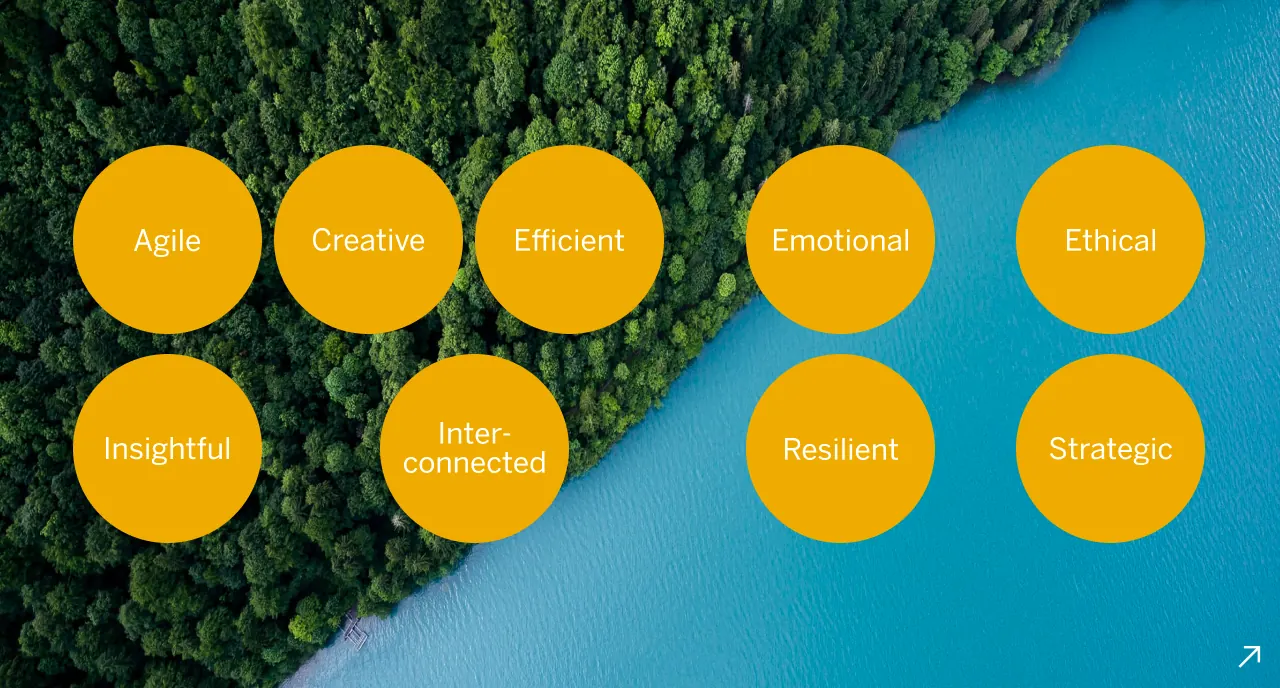
Intelligence is not just data or automation, or it is not just one skill. Equally as the intelligence of a person can be defined in a number of ways – including *abstract thinking, logic, understanding, self-awareness, learning, emotional awareness, reasoning, planning, creativity, and critical thinking *– we believe that businesses must also develop multiple intelligences to thrive in the future. You can also think of these multiple intelligences as a set of qualities that express the full potential of an organization. Those qualities include (but are not limited to):
Agile: Intelligent sustainable enterprises are highly flexible and able to reconfigure structure, processes, and organization to align value creation and delivery with the current market conditions.
Creative: Intelligent sustainable enterprises are creative. They are open to adapting their mindsets and following unusual paths to continuously find new ways of doing business and solve their pain points.
Efficient: Intelligent sustainable enterprises are smart, automated, and efficient. They connect people, process, and data to have a dual focus on day-to-day operation optimization and constant process innovation.
Emotional: Intelligent sustainable enterprises are emotional and human centered. They always take notice of the experiences of their customers, employees, partners, and suppliers. They do their best to understand the human sentiment and act upon it.
Ethical: Intelligent sustainable enterprises are caring and ethical. They accustom their organizations to fulfill their environmental and social responsibilities.
Insightful: Intelligent sustainable enterprises are insightful, and data driven. They leverage data as an asset when making both day-to-day and crucial decisions for the whole organization.
Inter-connected: Intelligent sustainable enterprises are well inter-connected within their network. They work on bringing their inner transformation to the whole society.
Resilient: Intelligent sustainable enterprises are resilient and profitable. They are able to cope with ongoing change and adapt swiftly. They continuously grow and thrive through crisis, disruption, and uncertainty, always aiming for long-term survival.
Strategic: Intelligent sustainable enterprises are strategic and future-proof. They plan their actions and the use of resources to achieve their long-term purpose, designed to keep them afloat in a fast-changing world.
How to Get Started
Each of these qualities of an intelligent sustainable enterprise can be tackled and developed individually. As each company is uniquely different, so are the programs that business leaders should implement to work towards this vision.
And yet, there are three core initiatives that each organization we are talking to is undertaking right now or about to start. These core initiatives touch on all qualities of the intelligent sustainable enterprise - consider them the quintessential basics to get yourself future-ready.
First, advanced digital transformation programs are the conduit of both the evolution and the disruption of business. IT and technology provide a platform for fostering and accelerating change. Introducing technology to those who shy away from it and providing opportunities for those who are tech savvy will fast track ideas to value while ensuring company resilience.
Secondly, business imperatives need to be tightly included in the above. With technology acting as “the glue”, business model and process re-engineering are both enabled and essential. Businesses that thrive to make the most out of the opportunity of technology driven change, are able to revisit the way they run and adapt their business, based on ideas from within and outside their own organization and the industry they operate in. This can lead to identifying new business opportunities, uncovering new value generation models, and finding better ways to execute their existing processes.
And last, but definitely not the least, in order to embrace the above, a mindset change is needed. It is a cliche to state that the world is changing rapidly, and yet, it is happening before our very eyes. Gaps between generations and social strata are widening, geopolitical tensions create ripple effects, and as a result, businesses are operating in an increasingly more unpredictable, more volatile environment. And so do all the people: customers, employees, partners. When change is the only constant, businesses need to develop a mindset – both on the organizational and each individual’s level – that copes with change, and even more, that embraces and thrives through change.

Food for Thought
The Ambidextrous Organization masters both its present and its future, argues Harvard Business Review.
The Future of Business is Composable, says Gartner.
BCG thinks that the CEO's Dilemma is building resilience in a time of uncertainty.
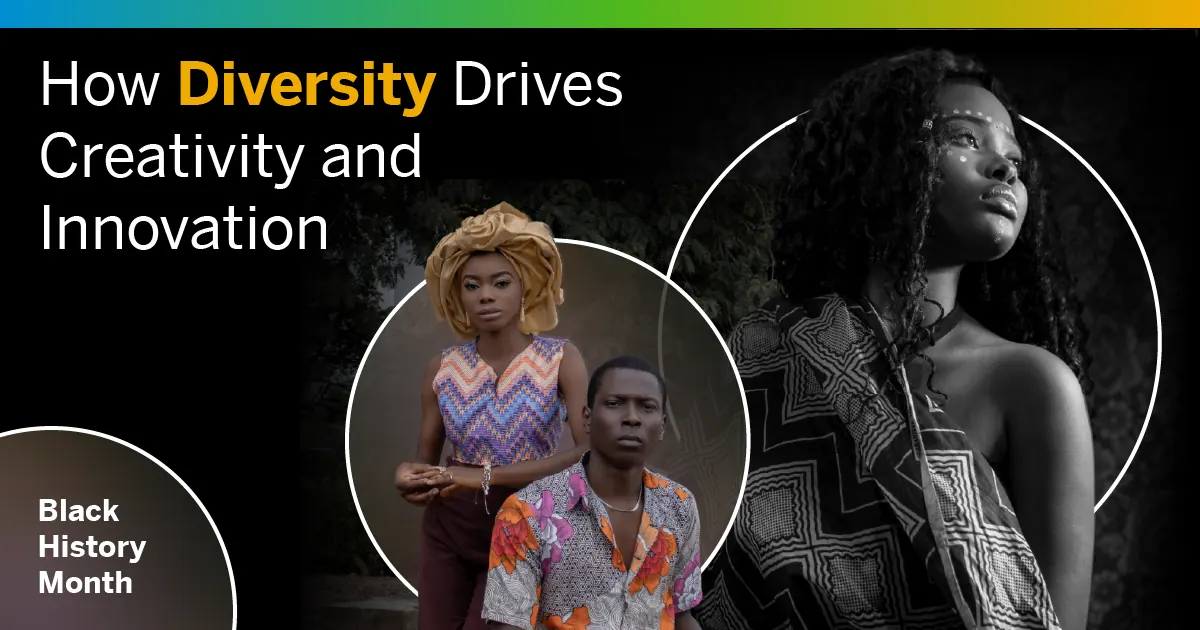
The Intelligent Enterprise Institute looks atBlack History Month to show how diversity drives creativity and innovation.
Snapshots
The Theory of Multiple Intelligences proposes that individuals possess different types of intelligences to discover the full range of human potential. In Davos, we asked delegates of the World Economic Forum 2022 what they would consider an intelligent choice.
▶ Video: watch it in the original issue on LinkedIn
Watch the full playlist below
▶ Video: watch it in the original issue on LinkedIn