Envision Beyond Journal
Trust in an Age of Mistrust
By Elena Kvochko & Jose Carvalho
Originally published
The issue is about Trust in an Age of Mistrust. Read and discover executive insights on the importance of trust in business and technology and how to build and measure organizational trust to establish a future we can all rely on.
Businesses and the innovative technologies they are developing can be at the forefront of providing solutions to the world’s greatest problems. However, mistrust in large organizations hinders the ability of many businesses to use technology to its full potential.
The world is evolving at a pace never seen before. The battle against climate change has already progressed from “raising awareness” to “demanding action”, inequality gaps are becoming wider and more visible, and sustainable practices are increasingly in demand. Private, commercial, and political stakeholders took action, which led to increased focus from businesses as well. Businesses have the ambition and the reach to make widespread change; and they have the means to make it happen through the usage of technology. In fact, powerful business processes leverage technology to achieve performance goals and optimization. Foremost, technology can be used proactively for research, analysis, and innovation that can in turn lead to new strategies and business models for a sustainable future. Technology can even be used as a tool for addressing one of the core tenets of trust – security.
What challenges the potential for progress is the reality that we live in an age of mistrust. Trust in large organizations, political agents, and even in technology itself, is declining. Roles such as politicians, advertising executives, bankers, and business leaders are among the most distrusted according to the Ipsos 2022 Global Trustworthiness Index. Current events associated with the unethical usage of technology, unethical business practices, and lack of transparency in actions and objectives, are having a negative impact on the ability to use technology at scale to bring about positive change.

Technology use from bad actors, like the entrance of deep fakes, digital cloning, or phishing scams, is on the rise, hence further technology adoption is perceived as fraught with risk. It is important for us to understand the role of trust in technology and business, what our roles as individuals and consumers of technology are, and how trust should be fostered so it can become a lever for businesses and technology to be able to address the world’s greatest challenges today and in the future.
The Role of Trust in Business and Technology
The first thing that comes to mind when trying to understand the role of trust is the question “why do we trust”? Why do we trust each other, technology, or a business? Why do we trust the directions of our GPS system, and why do we trust the recommendations of our music streaming platform?

On the most basic level, in our brain, trust is based on biochemistry as, according to studies, the hormone oxytocin increases both trust and trustworthiness in humans. This hormone can be naturally produced or inhibited, in different functions, and as a response to different stimuli, such as stress. If we abstract from biochemistry, there are a few external psychological factors that induce or reduce trust in people (e.g., “Trust Factors”):
Competence – the recognized ability to do or deliver what needs to be done
Integrity – demonstration of ethical behaviors
Benevolence – signs of kindness, how others are treated
Predictability – the ability to be consistent in outcomes
This construct also seems to be relevant when applied to business. According to PWC research, “87% of business executives believe that their stakeholders trust their companies” while only 30% of consumers and employees agree. When asked about what could earn their trust in an organization, customers responded with the products and services provided (i.e., related to predictability) but also stressed the importance of how employees are treated (benevolence), corporate citizenship (integrity), and the ability of leadership to admit and respond to mistakes (integrity and competence).
Interestingly, technology can have different roles related to trust and business. On the one hand, it can increase trust in business by increasing competence and predictability in business processes, ensuring products and services are delivered consistently, on time, and at the highest quality, as expected. Technology also has the capability of providing transparency on “Trust Factors”. It enables timely reporting, and the integration of this with additional insights (employee feedback, corporate citizenship reporting, etc.) gives us the impression that it may be easier to trust a technology-enabled business. On the other hand, technology adoption requires trust. Businesses, including technology providers, need to comply with data protection and privacy regulations, alert customers of outages or cyber incidents, communicate about solution updates, and recommend remediation efforts in the event of an identified vulnerability, all with the goal of delivering on customer commitments. To realize the full potential of technological progress and growth, successful innovators need to think and be transparent about the intended use of their technology, while preserving the privacy and security of the data they are processing. As in any sustainable relationship, that between the customer and vendor ought to be founded on trust, transparency, guidance, and value. And that trust needs to be pursued and prioritized by organizations and the people that make them up.
Being a Trustworthy Business
Fostering and leading with trust is good business!
In the past, businesses have quantified customer ‘trustworthiness’ in financial terms, when analyzing customer suitability or ‘creditworthiness’ and reliability for repayment. For example, when financial institutions decide to lend money or not, there is a metric to determine the financial risk of taking on this financial responsibility. It is only natural that now, customers are starting to look for the same quantification from businesses, for example, by seeking reviews, feedback, opinions, and ratings from previous customers prior to buying a product or a service, or by checking the safety records of a manufacturer before buying a car or a bike. For businesses, trust has an impact on both competitiveness and financial results. According to an Accenture review of more than 7,000 companies, those which recently experienced a drop in trust also experienced a decline on their competitive index, with losses of 13% of their own worth in future revenues. In extreme cases, companies lost 20% to 56% of their whole value due to a loss in stakeholder trust, as per additional findings from Deloitte.
Another important element of trust is that it begins from within, with the workforce of an organization. According to Harvard Business Review, employees at highly-trusted companies reported 74% less stress, manifesting in 106% more energy at work, and 50% higher productivity. Employees who trust their company are not only the best ambassadors for the business, but also crucial for its prosperity and growth.
Furthermore, just as trust binds people together, it also binds business partners together. In an increasingly complex and interconnected world, businesses need to look beyond their own boundaries and seek trustworthiness in the networks they belong to, it is not enough to be the trusted element of an untrusted network. The fact is that 70% of business networks that experienced failure when trying to scale up, reported trust as a critical factor for failure, according to BCG Henderson Institute.
Building and Measuring Trust
Trust is a precious, universal currency standard, and it needs to be treated as such. Its reach far exceeds any single business priority but can still be measured on an individual basis – alongside other key business indicators. Therefore, a strategy and framework to build, measure and maintain trust needs to be defined.
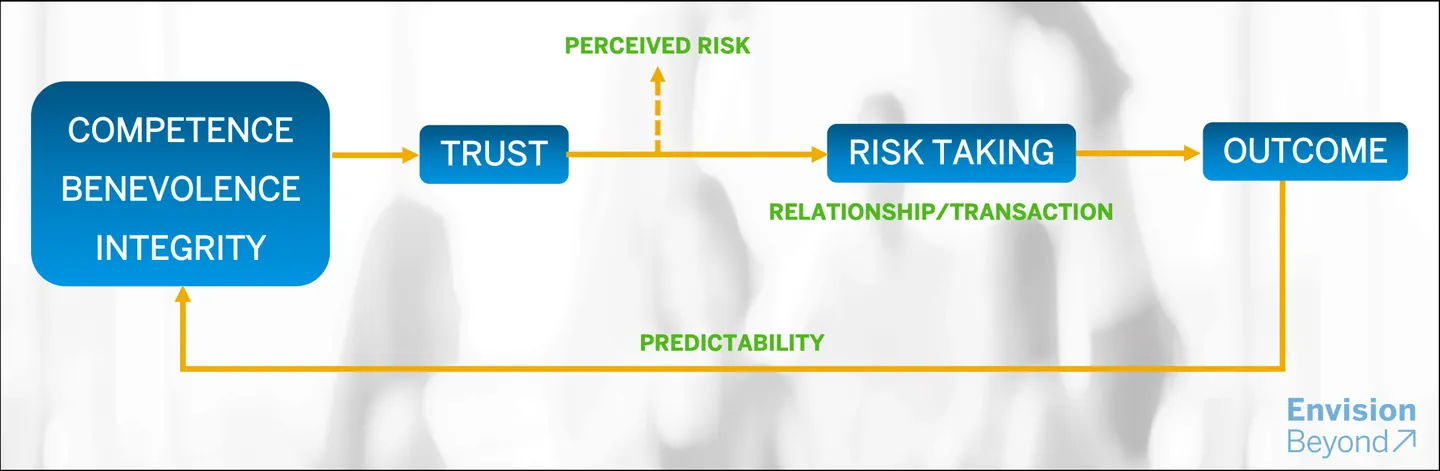
There are several approaches to modeling trust. One example we build off is the trust-confidence-cooperation model, where we take three of the key “Trust Factors” previously described (competence, benevolence, and integrity) as the basic inputs for an individual’s trust metrics prior to entering a relationship or transaction. That trust level will be a key factor in the perceived risk of entering such a transaction in the future. Once that risk has been taken, there will be an outcome that validates whether it was indeed worth it. It is the continuous application of this model that will then determine the predictability, the fourth “Trust Factor”, for further transactions in such a relationship.
In a business, it is possible to identify metrics that impact these four pillars:
Competence – Quality of the product/service, customer experience, usage of technology, innovation
Predictability – Strategy, reliability, process governance, and purpose
Benevolence – Sustainability practices, diversity, equity, inclusion, ESG, workforce experience
Integrity – Financial integrity, ethics, value statement and adherence to it, transparency, compliance, and data protection
Many of these metrics are available; bringing them into an integrated KPI framework will help businesses understand where to focus to increase trust levels.

For a technology-driven business, trust needs to be fostered throughout the entire vendor-customer relationship. For example, there is a higher level of responsibility for those that host personal and transactional data, and they must be transparent about how they are protecting this data, stay up to date with the latest regulations where their customers operate, and ensure the security controls they are deploying are appropriate and robust. In the event of a crisis, there needs to be a full and demonstrable commitment to accountability, where the business is transparent about shortcomings and clear about how they will remediate issues. For platform businesses, for example Airbnb, there is a need to proactively prevent users from misleading each other, with ID verification, guest reviews, and secure payment processes. As these measures are put in place, ways of monitoring and analyzing them will produce metrics to continuously evaluate and act on trust.
Building a Future We Can Rely On
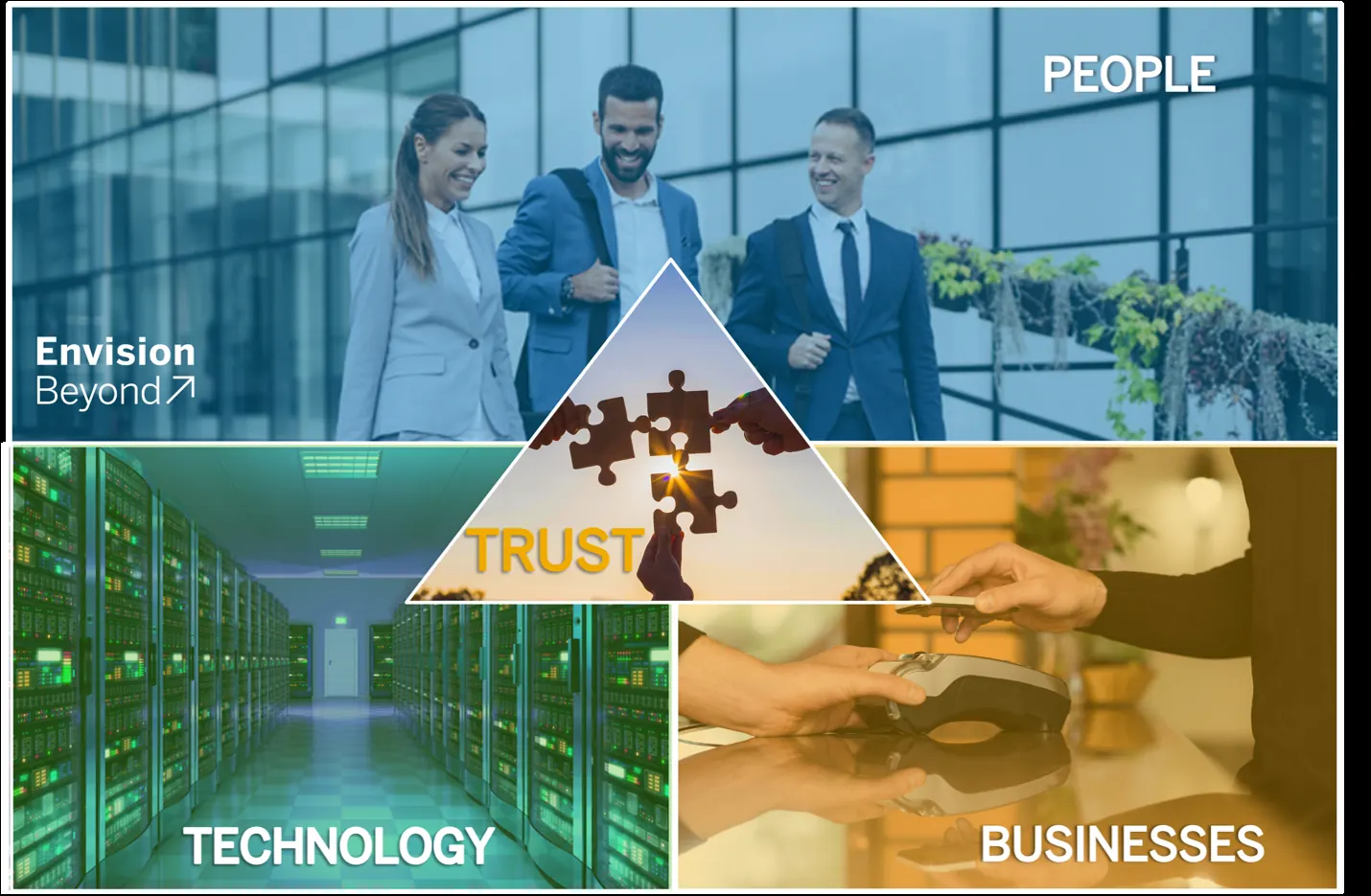
A sustainable future and business environment can only be achieved with trust. Trust is the foundation of the relationship between people, businesses, and technology.
The good news is that ten percent of Fortune 100 companies have started that journey, by establishing Trust Offices that aim to foster customer trust, across domains and industries. This demonstrates the weight of trust in advancing innovation, growth and progress for business and society. In technology, for example, this new business category – Trust – aims to address the growing demand for security, privacy, and transparency by stakeholders and users worldwide. Chief Trust Officers should also be passionate advocates on other trust issues depending on the needs of the business and its ecosystem, including diversity, equity, and inclusion. For example, at SAP, the Chief Trust Office aims to drive core leadership in setting responsible policies, frameworks, and processes with customers and users.
The next step is for all business leaders to act.
If your purpose is to help tackle the most prominent challenges of the world we live in, then make EARNING TRUST the top priority of your business imperatives. Nothing will empower your usage of technology more than this.
Food for Thought
Intelligent Enterprise Institute, stopped by atThe Trust Corner podcast ofSAP to discuss therole of technology in today's age of mistrust. Check out the full episode on Spotify, Apple Podcasts or openSAP.
How can we quantify the impact of truston a company’s** bottom line**? Find out more from Accenture.
Organizational trustis** multifacetedand needs to be evaluated at deeper levels**within the organization, argues Deloitte.
In high-trustorganizations, employees are more** productive, engagedand collaborative**. Explore the neuroscience of trust withHarvard Business Review.
It is not enough to be the trusted elementof an** untrusted network**. Read here from BCG Henderson Institute on how to deliberately designtrust in business ecosystems.